
Where Can I Find Cuban Salsa Dance Classes in Dublin? Your Complete Guide
January 4, 2026 • Dublin Salsa Academy
Learning a dance move is not the objective. Becoming a dancer is the aim.
The majority of people in Dublin, who wish to learn Cuban salsa dance choose the incorrect technique. They do not pay attention to the mechanism that produces the desired result. Instead, they only pay attention to the final product, such as executing a sophisticated turn pattern or seeming fluid on the dance floor. They drag themselves to a studio using their willpower, believing that if they put in enough effort, they would ultimately "get it."
Willpower, however, is a limited resource. You will ultimately lose if you have to battle yourself to attend class each week.
The alternative is to build a system where learning to dance becomes inevitable. You do not rise to the level of your goals; you fall to the level of your systems. If you want to master Cuban salsa, you don't need more motivation. You need a better environment.
This guide is not just a list of classes. It is a strategy for designing an environment where learning to dance is the path of least resistance.
The Difference Between Motion and Action
First, we must define the game we are playing.
In the world of Latin dance, there is a distinction that often confuses beginners: the difference between Linear Salsa and Cuban Salsa.
Linear salsa (often called Cross-Body) is geometric. It is danced in a slot. The partners move back and forth along a straight line, like a tennis match. It is precise, often flashy, and highly technical.
Cuban salsa (Casino) is circular. It is danced in a sphere. The partners move around each other constantly, rotating 360 degrees. This is not just a stylistic difference; it is a fundamental shift in physics.
This distinction matters because of the Law of Specificity: You become what you practice.
If you practice Linear salsa, you are training yourself for precision and display. If you practice Cuban salsa, you are training yourself for connection and flow. The Cuban style is rooted in Afro-Cuban traditions like Son and Rumba. It is grounded. The movement is relaxed. The hips move naturally, not because you are forcing them, but because your feet are connecting with the floor in a specific way.
For the beginner, Cuban salsa offers a unique advantage: it lowers the barrier to entry. The footwork is simpler than other styles. You don't need to master triple-spins to enjoy a song. You just need to walk in rhythm. This allows you to enter the "Goldilocks Zone" of habit formation—a task that is difficult enough to be engaging, but simple enough to be doable.
Environment Design: How to Choose a Studio
When you are deciding where to learn in Dublin, you are not just buying a class. You are choosing the environment that will shape your habits for the next six months.
Behavior is a function of the Person in their Environment. $B = f(P,E)$.
If you choose a studio that is difficult to get to, has a competitive atmosphere, or lacks social opportunities, you are increasing the friction between you and your new habit. You are making it hard to be a dancer.
To choose the right academy, we can apply the Four Laws of Behavior Change:
Make It Obvious (Location and Cues)
Your environment should cue your good habits. If your dance studio is hidden in a remote industrial estate, you will find excuses not to go. You want a location that intersects with your existing daily routine.
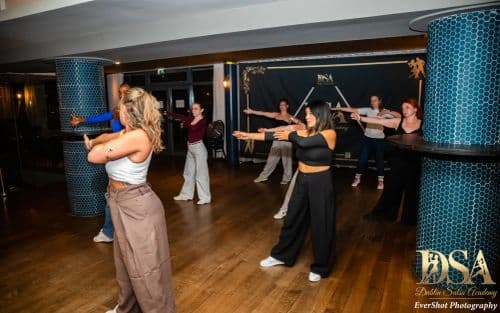
In Dublin, academies like Dublin Salsa Academy have optimized for this by securing a central location at the Harbourmaster in the city center. This reduces the friction of travel. You don't have to "go out of your way" to dance; it simply becomes a stop on your way home.
Make It Attractive (Community)
We imitate the habits of three groups: the close, the many, and the powerful. You want to join a tribe where your desired behavior is the normal behavior.
Look for a school that mixes levels appropriately. You need a "Beginner Cohort"—a group of people starting at zero, just like you. This creates a shared identity. You aren't the clumsy new person; you are part of the "January Class." This social reinforcement makes the habit attractive.
Make It Easy (The Schedule)
The most effective way to start a new habit is to reduce the friction associated with starting.
Most academies in Dublin offer a standard 6-week cycle. This is good, but flexible intensity is better. Some students can only train once a week. Others want to immerse themselves.
The best systems allow for repetition. Dublin Salsa Academy, for example, runs Cuban salsa classes on Mondays (18:30), Tuesdays (20:30), and Wednesdays (19:30). This redundancy is crucial. If you miss Monday, the system doesn't break; you just go Tuesday. The "chain" of your habit remains unbroken.
Make It Satisfying (The Reward)
This is the most critical variable. What is the immediate reward for dancing?
In a poorly designed class, the reward is delayed. You drill steps for an hour, go home, and maybe in six months, you go to a club. That is too slow for the human brain.
In a well-designed class, the reward is immediate. You learn a step, and then you use it.
The Cumulative Advantage of Dublin Salsa Academy
I rarely endorse specific businesses, but I do endorse efficient systems. When we analyze the structure of Dublin Salsa Academy, we see a system designed to maximize habit retention.
They have implemented a feature that acts as a "commitment device" for learning: The Post-Class Social.
Every single class at their Harbourmaster location concludes with a social dancing session, running as late as 23:00 or 23:30.
This effectively "stacks" a new habit (social dancing) on top of a current habit (taking a class).
The Cue: The class ends.
The Routine: You stay for the social.
The Reward: You connect with other humans and feel the joy of movement.
By combining instruction with play, they bridge the gap between "knowing" and "doing." You are not just memorizing choreography; you are learning a language by speaking it immediately.
Furthermore, their scale provides stability. With over 335 five-star reviews, they have the volume to maintain distinct levels. You won't be thrown into a room with advanced dancers and left to drown. You will progress from Beginner to Improver to Intermediate, mastering each stage before moving to the next.
The Identity Change
Ultimately, your goal is to shift your identity.
The goal is not to "take a salsa class."
The goal is to "be a salsa dancer."
The difference is subtle but powerful. When you view yourself as a dancer, you don't need to force yourself to practice. It's just what you do.
The easiest way to change your identity is to cast a vote for it.
Every time you attend a Monday class, you cast a vote for "I am a dancer."
Every time you stay for the social and ask a stranger to dance, you cast a vote for "I am confident."
Every time you stumble, laugh, and keep moving, you cast a vote for "I am resilient."
As these votes accumulate, the identity shifts. You stop worrying about looking foolish and start focusing on the connection.
How to Start (The 2-Minute Rule)
If you are currently sitting on the couch, reading this on your phone, you might feel overwhelmed by the idea of a 6-week course.
Apply the 2-Minute Rule: Scale the habit down until it takes less than two minutes to do.
Don't worry about the six weeks. Don't worry about the shoes. Don't worry about finding a partner.
Just do this: Book one trial class.
That's it.
Most Dublin academies, including Dublin Salsa Academy, offer trial classes for €5–€10. It is a low-stakes experiment.
Go to their website.
Find the "Book Trial" button.
Click it.
Once you have booked, the commitment is made. The environment will take over.
For the upcoming cycle, enrollment dates are typically mid-month (e.g., January 12–14), with the window closing shortly after (January 19–21). The deadline is a useful constraint—it forces a decision.
Conclusion
We often think that competence creates confidence. We wait until we are "good enough" to go dancing.
But in reality, confidence is just the result of previous evidence. You build confidence by showing up, week after week, and proving to yourself that you can do it.
Cuban salsa is not about perfection. It is about connection. It is about the circle—the constant, flowing exchange of energy between two people.
You have the information. You know where to go. The system is waiting for you.
The only remaining step is to take action.
Recent Posts
October 7, 2026
Dance Classes for Couples in Dublin: A Date Night That Actually Works
How dance classes for couples work in Dublin, what four weeks cost for the two of you, and where you can learn together at Harbourmaster in the IFSC.

September 28, 2026
Salsa Dancing in Dublin Tonight: The Three Nights You Can Actually Dance
Where to dance salsa and bachata in Dublin this week: three nights a week, one city centre floor, €5 at the door, and no partner needed.
September 25, 2026
What Is Bachata? The Dance, the Music and the Three Styles Explained
Bachata is a guitar-led dance from the Dominican Republic, counted in fours with a tap on the last beat. Here is what the music is, how the steps work, and which style Dublin teaches.