What Is Bachata? The Dance, the Music and the Three Styles Explained
September 25, 2026 • Dublin Salsa Academy
Bachata is a dance and a genre of music that started in the Dominican Republic. It is counted in fours, and the basic pattern is three steps and a tap.
If you have heard the word and still cannot picture the dance, here is the short version:
• Where it is from: the Dominican Republic, guitar-led, romantic, and older than most people assume. • The count: three steps, then a tap, over and over, in a 4/4 rhythm. • The styles: traditional Dominican, modern, and Sensual Bachata, which is the one we teach in Dublin. • The feel: slower than salsa, closer than salsa, and easier on a first night than most people expect.
Where Bachata Comes From
Bachata grew up in the Dominican Republic as guitar music played in bars, yards and front rooms, and for decades it was treated as the music of the poor.
It was suppressed during the Trujillo years, dismissed by polite society after that, and then carried out of the Caribbean by Dominican communities. When Juan Luis Guerra released Bachata Rosa in 1990, the rest of the world started listening.
Bachata runs on a four beat rhythm. You step three times and mark the fourth beat, then repeat it on the other side. Count it out loud and it sounds like 1, 2, 3, tap, 5, 6, 7, tap.
That fourth beat is what trips beginners up. Usually it is a touch of the floor with the free foot, sometimes it is a lift of the hip instead, and either way you are not travelling on it.
The tempo is slower than salsa, which is why the steps land sooner than people expect.
If the counting itself is the confusing part, why dancers count to eight explains where the numbers come from.
What Bachata Music Sounds Like
The music is led by a guitar that repeats a short melodic line for the whole song, with percussion underneath and a bass holding the tempo steady.
The vocals are in Spanish and the subject is usually love, loss or longing, which is why bachata gets called the sad music people dance to.
Tempos range from slow and melodic, which is what Sensual Bachata suits, to fast and percussive, which is where the traditional Dominican form lives.
The Three Styles You Will Hear Named
Traditional, or Dominican, bachata: the original form. Faster, percussive, full of small footwork, and closest to the music's street roots.
Modern bachata: the radio version. Slower and simpler, built on side to side steps, and the friendliest place for a beginner to start counting.
Sensual bachata: the European branch, with Spain as its main hub. Body waves, isolations and dips, danced to slower melodic tracks, with the traditional timing still underneath. This is the style at our bachata classes in Dublin.
Why Beginners Often Find Bachata Easier Than Salsa
The basic pattern repeats every four counts, so there is less to hold in your head in week one. Salsa hands you more footwork and more timing choices from the first class.
That is not a verdict on which dance is harder. It is the reason most people who try both find their first bachata class the calmer of the two.
What Your First Bachata Class Looks Like
The teacher walks the room through the basic step, then you dance it with a partner and change partners every few minutes. You do not need to bring anyone, and you do not need to have danced before.
One hour a week for four weeks. By the end of Level 1 you can hold the basic step, lead or follow a few simple turns, and stay on the beat through a whole song.
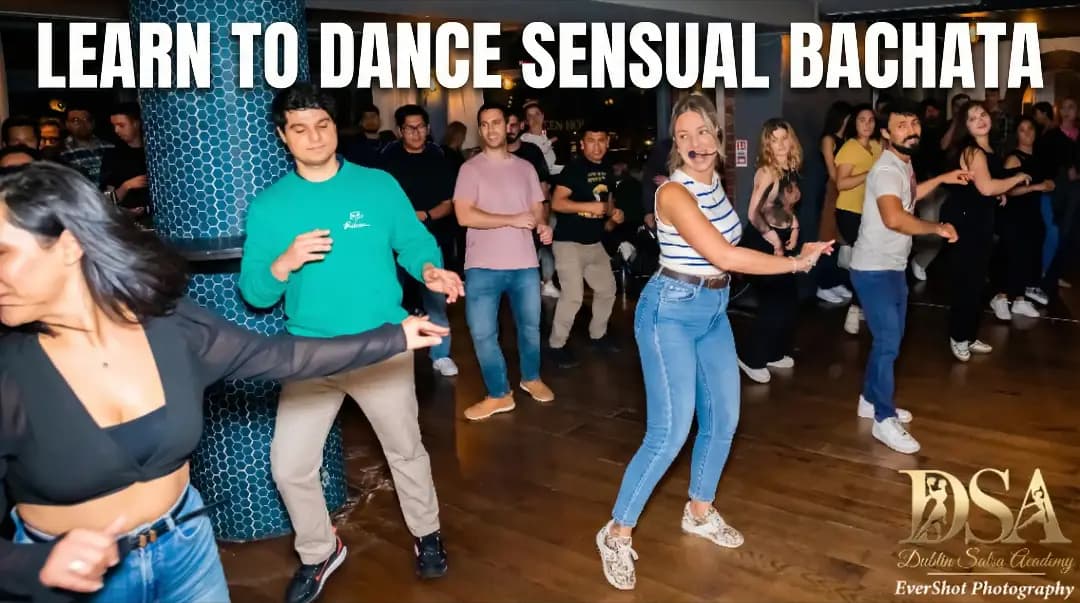
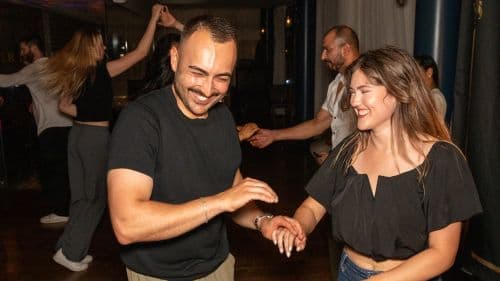
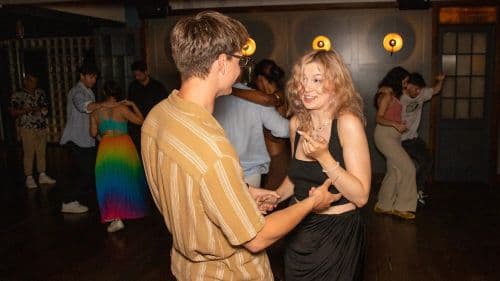
Sensual Bachata in motion at a Dublin Salsa Academy workshop.
Start With Sensual Bachata
Level 1 Bachata in Dublin
Four weeks of Level 1 is €45, one hour a week, and you do not need to bring anyone with you. Monday at 20:30, Tuesday at 19:30 or Wednesday at 20:30 at Harbourmaster in the IFSC.
Do I need a partner? No. Everyone rotates during class, so nobody stays with the same person for long.
Is bachata hard to learn? The basic step is one of the friendlier ones in Latin dance. The styling takes longer, and that part is genuinely fun.
What if I have no rhythm? Rhythm is trained, not inherited. Counting out loud while you move is what class is for.
Is bachata only for couples? No. Most people in a beginner class arrive on their own.
What do I wear? Clothes you can move in, and shoes that will not slide off your feet. Jeans and trainers are what most people wear.
How long until I can dance a full song? Four weeks in you have the basics. Keep going weekly and the count stops being something you think about.
Where does the name come from? Bachata was a Dominican word for a party or a good time before it was ever the name of a dance.
Learning Bachata in Dublin
Sensual Bachata runs three nights a week at Harbourmaster on Custom House Quay, in the IFSC: Monday at 20:30, Tuesday at 19:30 and Wednesday at 20:30. Pick whichever night fits your week.
Beginners start with a four week Level 1 course for €45, or eight weeks for €85. Every price sits in the open on the pricing page, and the full timetable shows what else runs on the same night.
The academy is rated 5/5 from 393 reviews, and the social after class is where the steps you just learned start to stick.
Three Nights a Week in the IFSC
Bachata Classes in Dublin
Level 1 starts on fixed dates every month. Four weeks, €45, no partner and no experience needed, five minutes from Connolly Station.